

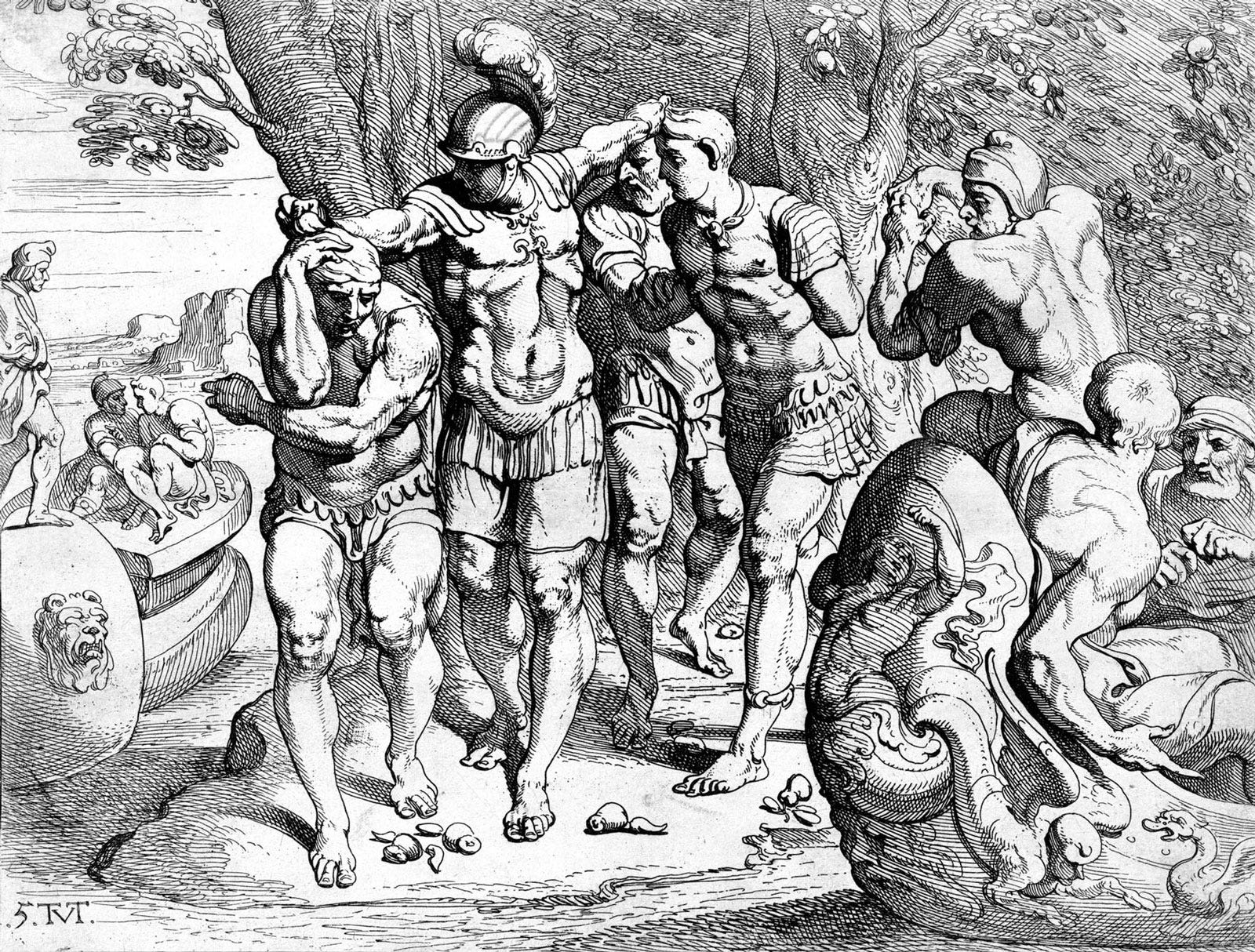
You may have forgotten the scene: after nine days of Zeus-hurled violence at sea, Odysseus and his men finally round Malea and beach their remaining fleet on the beautiful, leafy land of the Lotus Eaters. Spent, they draw fresh water and share a long-overdue meal in the shade of the fast ships before Odysseus dispatches two scouts and a herald to discover if the Lotophagi are hostile or hospitable to strangers. His men do not return. Leaving his remaining crew at the shoreline, Odysseus goes in search of his lost men, anticipating some new malevolence. Instead, he finds the three men, unharmed, surrounded by a gathering of inert, smooth faces. I imagine them variously prone and supine before these statued natives, moving as though encircled by slow, delicious air, stretching their stringy, leathered arms across the soft floor of leaves. See the thin rosy line of spittle crawl from the corner of one of their drooping jaws, tugged spasmodically by the slight slick suggestion of a smile. Tick. Tick. Tick. Another steadies himself on his feet and reaches, dream-like, for a dull yellow cluster of blossoms, grasps the large amber husk of fruit with the complete attention of a toddler learning to use their hands, pincer-like, for the first time. From the cover of another stand of trees, Odysseus watches his herald methodically begin to worry the skin like a black bear until it splits open and throbs out a honey-sweet pulp he gnaws as much as slurps. He is not hungry, but he eats and eats and eats the fruit as though it held a secret that might dissolve into air. Their flat eyes swing about in confusion at Odysseus’s sudden, rising voice and his rough hands. The herald tries to summon his un-wiped mouth but manages only to drawl out a groan. The scouts, too, are moving like men underwater. Odysseus’s eyes seem far away and wild and his words thump like blunt percussives without shape – Ith-a-ca . . . Sa-mos. . . Za-cyn-thus . . . Du-lich-ium. Home! he roars, but their mute upturned faces register nothing. He shouts the names of their wives and children, the names of their aged parents, the names of their comrades, but each name lands like a pestle on the muscles of their face until they are nearly as smooth and expressionless as the Lotophagi themselves. Seizing hold of their heavy limbs, Odysseus desperately begins dragging them back to the ships. His men have discovered their voices and are weeping now, wailing and pleading, attempting to free themselves and crawl back to taste more fruit. The Lotus-Eaters simply stand and watch, bemused, turning like a field of sunflowers as Odysseus hauls his quarry from the thicket past the bleach-bone border of their collective dream.
The reason we may forget this episode is that it only occupies the space of 23 lines in an epic of over 12,000 lines. In his film adaptation, Christopher Nolan drops the scene entirely. Yet narratively, the episode with the Lotus-Eaters is brief precisely because Odysseus recognizes the severity of the danger it presents for himself and his men and acts immediately to nullify it. More threatening than the brute violence of war is the danger of the Lotus-Eaters’ death-in-life, a form of stupefaction produced when desire is inflamed and satisfied in a closed, impulsive circuit—simultaneously effulgent and vacuous—like a continually collapsing star. Odysseus’s horror at seeing how this bright emptiness has swallowed his men’s desire for home is probably something like the feeling I had a few years ago reading about a town in the American rust belt where police kept discovering cars left running on the sides of main roads—some stalled in the middle of intersections—with men and women high on fentanyl slumped over their steering wheels while their infants screamed and cried in their car seats and eventually fell silent.
Behold, the end of all things.
And this, in fact, is how the devil wants the world to end—not in a clear-eyed conflagration of good versus evil but in a brave new world of total amnesia and dumb delight. It is, sadly, a tale as old as the West itself.
From Homer onward, Greek epic breaks along two main categories of storytelling: stories of war, or polemos (à la The Iliad), and stories of homecoming, or nostos (à la The Odyssey). In its way, each narrative tradition interrogates the nature of desire—in the former case, the desire for one’s personal honor and glory, in the latter, the desire to see one’s home again, to be restored to one’s family, friends, land, and responsibilities. In a story like The Odyssey, nostos describes both the goal of one’s deepest longing (home) and the journey required to successfully arrive there. So in English translations of the text, “home” comes to function as a shorthand for one’s ultimate commitments as well as the force those commitments exert upon one’s actions and decisions. Every episode of Odysseus’s journey is therefore a trial that will either prevent or advance his homecoming.
And this, in fact, is how the devil wants the world to end—not in a clear-eyed conflagration of good versus evil but in a brave new world of total amnesia and dumb delight. It is, sadly, a tale as old as the West itself.
The Odyssey opens with Odysseus weeping on the shores of the goddess Calypso’s island after being trapped for seven years by her craft and his own desire. More disturbingly, the delay at Calypso’s island technically occurs long after the episode on the island of the Lotus-Eaters, which is virtually the first trial Odysseus and his men experience after leaving the ruined walls of Troy. This highlights the fact that early on in the journey, the desire for home is clear, sharp, and decisive, a non-negotiable conviction for Odysseus that directs his actions. But as his trials concatenate, time, exhaustion, pain, and distraction begin to dim the bright images of his home in Ithaca, and the desire for pleasures that do not have to be delayed takes their place. Nolan’s way of handling this is to transplant the lotus fruit from the island of the Lotophagi to the island of Calypso, where, out of sympathy for her traumatized visitor, the resident goddess crushes the lotus fruit into something like a powder and administers it to Odysseus like a doctor writing an endless prescription for OxyContin. This allows Nolan to paint Odysseus in a much more sympathetic light regarding his faithfulness to Penelope because the seven years on Calypso’s island are not treated like a fear-and-loathing episode of erotic self-annihilation so much as a well-meaning, but ultimately misguided, experimental therapy for PTSD via goddess-induced amnesia. It is a clever way of folding the Lotophagi episode into Calypso’s desire for Odysseus, but it completely blunts the role Odysseus’s own desire plays in his decisions. In Homer, Odysseus participates in his own imprisonment for years until Calypso’s power to please him finally wanes, and his desire for home revives, eventually to the point of agony:
His eyes were always
tearful; he wept sweet life away, in longing
to go back home, since she no longer pleased him. (Odyssey V.151-3)
Even a goddess’ offer of immortality and endless pleasure is not finally enough to erase the longing for home. Zeus compels Calypso to release Odysseus, and her anger is palpable as she chastises Odysseus for wanting to return to a life of suffering, diminished pleasure (insofar as she associates pleasure with beauty and mocks Penelope’s homeliness), and death. Calypso is repulsed by humanity and its limitations.
We have always known Calypso: she is the dragon in the garden offering Eve free supplements, the Candy Crush level that never ends, that little countdown circle on Netflix that loads the next thing you didn’t want to watch before the thing you wanted to watch ends; SHE IS ALL BETTING ON ANYTHING WHATSOEVER; she is the perfect American algorithm of pornography, conspiracy theories, elective surgery, and parenting advice; she is Peter Thiel’s Christ and the AI girlfriend talking to your 12-year-old son right now; she is Iceland’s declaration that it has virtually eliminated the presence of Down’s Syndrome, and she is one more beer with that co-worker before you have to text your spouse you’re on your way home. Calypso is whatever desire would turn us from the commitments, limitations, and persons the Lord has called us to.
Calypso is whatever desire would turn us from the commitments, limitations, and persons the Lord has called us to.
Dante believed Calypso won in the end. Writing 2,000 years after Homer, the Italian poet describes an encounter between Dante and Virgil and the shade of Odysseus in hell, where he reveals an epilogue to his story Homer never wrote. Odysseus confesses that after all of his suffering and longing and adventuring, his great homecoming only satisfied him for a time, but eventually his ambition for more boiled until it boiled over:
Not sweetness of a son, not reverence
for an aging father, not the debt of love
I owed Penelope to make her happy,
could quench deep in myself the burning wish
to know the world and have experience
of all man’s vices, of all human worth. (Inferno XXVI.94-99)
Dante knew that for any of us, home is not finally enough, that the lotus fruit will inevitably grow in the hills and valleys of Ithaca itself, in the best intentions of kingship, sonship, fatherhood, even in the sacred place of marriage. And it would do so in part because none of us are truly home yet. As the Teacher of Ecclesiastes reminds us, God has sewn into the fabric of all human hearts a desire for more than this world can provide, a desire for a form of life marked by “eternity,” an olam we can neither fully inhabit nor fully ignore. Eternity is the place of God’s time, the place from which Jesus Himself has come and to which He must return. Eternity is Jesus’ Father’s Home, and “eternal life” is the gift of our being welcome there as those who know and belong to the Father because we have trusted the Son He sent to rescue us from this haunted, sun-kissed land of Lotus Eaters.
But what, then, of our own homes? What of the people, responsibilities, and limitations Calypso mocks, the lotus fruit numbs, and Odysseus himself strains against? Unto themselves, it is true, our humble homes and ordinary lives cannot satisfy the deepest desires of our hearts, but in Christ, our homes are transformed into a doorway to the Father’s home—our marriages, families, churches, schools, friends, neighbors, commitments, and responsibilities become the halyard of our discipleship, the oars to which we bend our obedience and love for Christ. For it is how we faithfully live in our human weakness, how we love those nearest us, that we obey the commands of Christ and press forward, ever onward, past the Lotophagi, past the sirens and Calypso, past Scylla and Charybdis, past the doleful realm of shades and shadows, past the gods’ own prison house of lust and rage, past narcissism and consumerism, past cynicism and despair, until we see that bright country on that distant shore and know, at last, we are home in the House of God forever.
For it is how we faithfully live in our human weakness, how we love those nearest us, that we obey the commands of Christ.
LET’S TAKE IT FURTHER
The things that call us home are often surprisingly ordinary: the people we have been given to love, the responsibilities we have been asked to carryPacifica Christian High School, Orange County, and the commitments we are tempted to escape. Received faithfully in Christ, these can become part of our journey toward our true home.
A Question: What is one key relationship or responsibility in your life that should ground you in the desire for your true home?
A Practice: Take a moment to write down some fresh ways you can cultivate that relationship or responsibility in a “homeward” direction.
Do you want to read with us this year?
The Pacifica Book Club invites parents, alumni, and friends to join us in one of the oldest and richest human endeavors: reading great books in the company of friends.